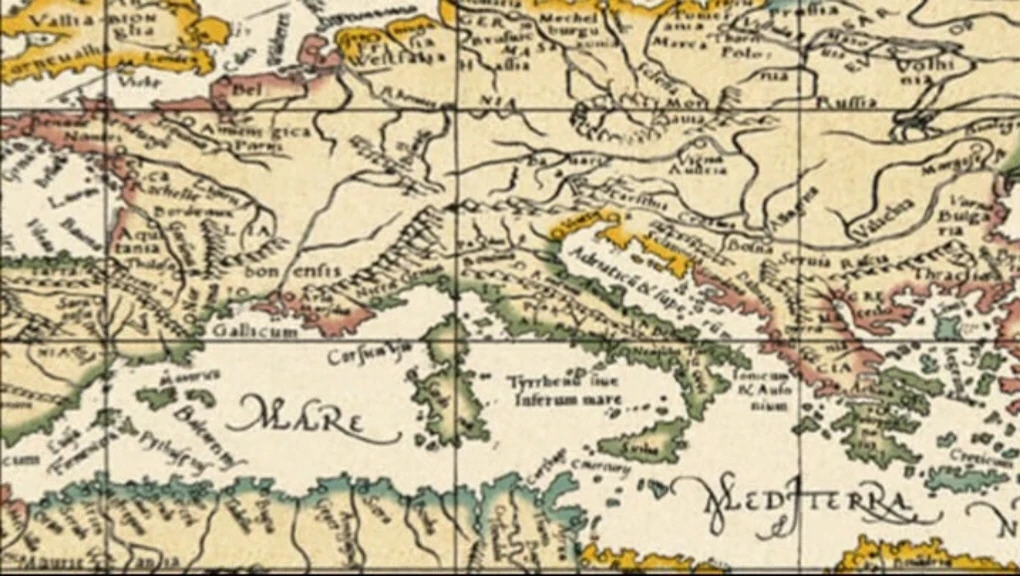
The Mediterranean Sea
- "I insist that you leave the Mediterranean at once! These are our waters!"
"AHEM. MY waters. You should all get back to your own territories tout suite! That means you, too, Eduardo and Ammand! Next time I catch you here, I will carve you all into bits and feed you to Fifi!" - ―Eduardo Villanueva and Chevalle
The Mediterranean Sea was an intercontinental sea situated between Europe, Asia, and Africa. The countries surrounding the Mediterranean and its marginal seas in clockwise order include Spain, France, Italy, Greece, Turkey, Egypt, and Morocco. It was surrounded by the Mediterranean basin and almost completely enclosed by land: on the east by West Asia, on the north by West Asia and Southern Europe, and on the south by North Africa. To its west it was connected to the Atlantic Ocean via the Strait of Gibraltar that separates the Iberian Peninsula in Europe from Morocco in Africa; additionally, it is connected to the Black Sea through the Bosporus strait that intersects Turkey in the northeast and the Red Sea in the southeast.
The history of the Mediterranean region saw the emergence of some of the earliest and most advanced civilisations, including those of Egypt and Greece. The Roman Empire maintained nautical hegemony over the sea for centuries and was the only state to have ever controlled all of its coast. The Mediterranean Sea was an important route for merchants, travellers, and migrants in antiquity, facilitating trade and cultural exchange between various peoples as well as colonisation and conquest.
History
By the Age of Piracy, many a story of pirates ran through the oceans of the world, from the Caribbean to the Mediterranean round to the Asian seas.[1] The Kraken was a great leviathan of the deep whose legend had been told by sailors throughout time, described in European, Mediterranean, and Asian sailing lore,[2] most notably serving Davy Jones, the captain of the Flying Dutchman.[3]
Capitaine Chevalle was the Pirate Lord[4] of the Mediterranean Sea,[5][6][7][8] no later than when Jack Sparrow was nine years old.[9] Jack Sparrow had spent most of his life at sea, sailing on a lot of bodies of water, including the Mediterranean, by the time he left the pirate's life, was under the employ of the East India Trading Company, and returned to the pirate's life.[10] Following the quest for the Shadow Gold by Captain Jack Sparrow and the crew of the Black Pearl, Eduardo Villanueva insisted that Sparrow leave the Mediterranean, though Chevalle argued with Villanueva and Ammand about their territories.[9]
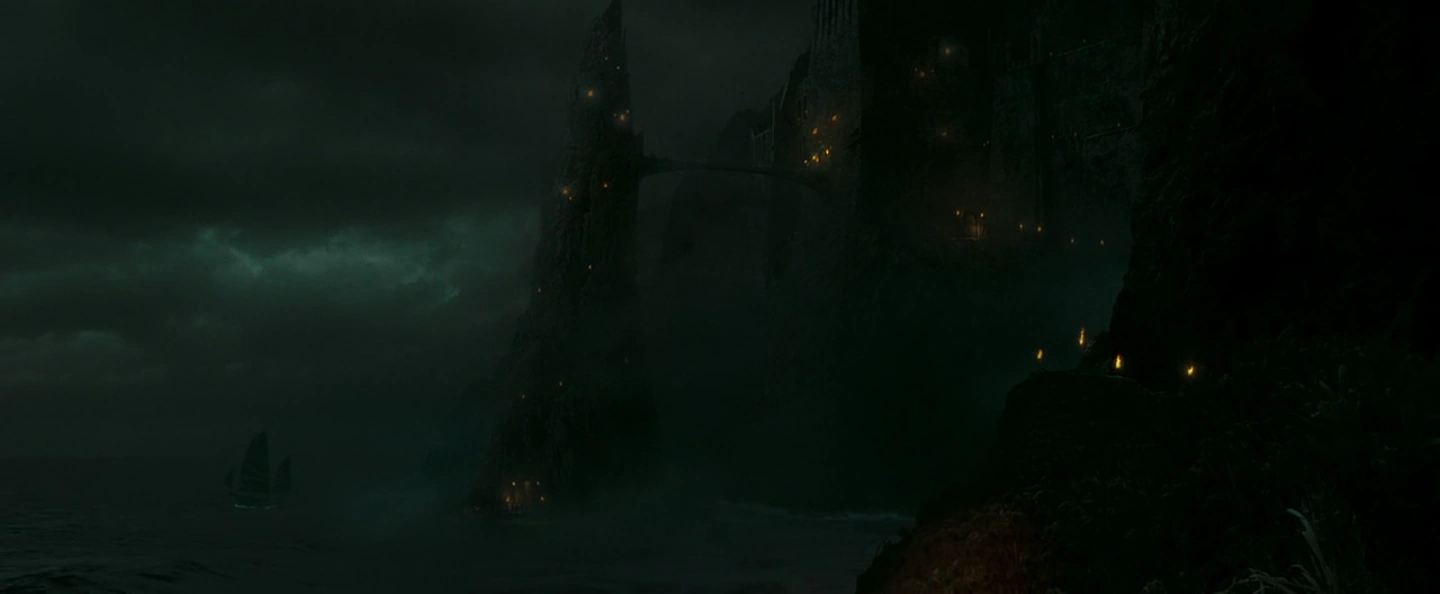
The Turkish prison was located on the Mediterranean Sea.
Over thirteen years after Captain Jack Sparrow's deal with Davy Jones,[3] knowing he was running out of time before his debt needed to be paid, Sparrow purposely allowed himself to be captured by the corsairs off the Canary Islands and was taken to the Turkish prison on the Mediterranean Sea,[11][2] which was depicted in at least one world map.[12] There he acquired a drawing of the key to Dead Man's Chest, the very container that holds Jones' still-beating heart, and escaped via coffin in the Mediterranean.[3] The Black Pearl made its way to the Mediterranean to rescue its wayward captain from his floating coffin, though Sparrow's crew were confused as they set off in search of the key and what the key might unlock, without being told what that is.[3]
During the search for the Chest led by Lord Cutler Beckett of the East India Trading Company, the Mediterranean Sea was drawn onto a map of the world created in the EITC headquarters in Port Royal,[3][13][14][15] along with a smaller map in the captain's cabin of the Endeavour during Beckett's war against piracy.[4]
Behind the scenes
The Mediterranean Sea first appeared through escape from the Turkish prison as depicted in media relating to the 2006 film Pirates of the Caribbean: Dead Man's Chest.[3] While unidentified in the film, the prison was first defined as being located in the Mediterranean through the film's promotion guide,[11] a world map featured in the video game adaptation of Pirates of the Caribbean: At World's End,[12] and confirmed by the description of the Turkish Prison in the 2010 update of the Pirates of the Caribbean website.[2] The Mediterranean Sea was first identified by name in media relating to At World's End, which featured Chevalle, the Pirate Lord of the Mediterranean, originally detailed in online sources,[5] including the official website.[6]
The Mediterranean would be mentioned in On Stranger Tides,[16] the 1987 novel used for the 2011 film Pirates of the Caribbean: On Stranger Tides.[17]
Appearances
- The Price of Freedom (Mentioned only)
- Legends of the Brethren Court: Wild Waters
- Legends of the Brethren Court: Day of the Shadow
- Pirates of the Caribbean: Dead Man's Chest
- Pirates of the Caribbean: Dead Man's Chest (junior novelization) (First appearance)
- Pirates of the Caribbean: At World's End (Picture only) (Map only)
Sources
- DisneyPirates.com (First identified as Mediterranean Sea)
- Pirates of the Caribbean: The Visual Guide (First pictured)
- Pirates of the Caribbean: The Complete Visual Guide
- Pirates of the Caribbean: The Curse of the Black Pearl: "Scoundrels of the Seas"
- Pirates of the Caribbean: At World's End: "Inside the Brethren Court"
External links


Notes and references
- ↑ Pirates of the Caribbean: The Curse of the Black Pearl: "Scoundrels of the Seas"
- ↑ 2.0 2.1 2.2 DisneyPirates.com
- ↑ 3.0 3.1 3.2 3.3 3.4 3.5 Pirates of the Caribbean: Dead Man's Chest
- ↑ 4.0 4.1 Pirates of the Caribbean: At World's End
- ↑ 5.0 5.1 At World's End Pirate Lords photos on Yahoo! Summer Movie Guide: Capitane Chevalle (backup link archived on May 12, 2007)
- ↑ 6.0 6.1 DisneyPirates.com: Pirates of the Caribbean: At World's End: Pirate Lords Map
- ↑ Pirates of the Caribbean: The Complete Visual Guide, pp. 90-91: "Pirate Lords"
- ↑ Pirates of the Caribbean: At World's End: "Inside the Brethren Court"
- ↑ 9.0 9.1 Legends of the Brethren Court: Day of the Shadow
- ↑ The Price of Freedom, Chapter One: Fair Winds and Black Ships
- ↑ 11.0 11.1 Dead Man's Chest.pdf Michael J. Ricciardi - Copywriter (June 1, 2006) (backup link)
- ↑ 12.0 12.1 Pirates of the Caribbean: At World's End (video game).
- ↑ Pirates of the Caribbean: The Visual Guide
- ↑ Pirates of the Caribbean: The Complete Visual Guide
- ↑ The Secret Files of the East India Trading Company
- ↑ On Stranger Tides, Prologue
- ↑ Pirates of the Caribbean: On Stranger Tides