| For other uses, see Map (disambiguation) |
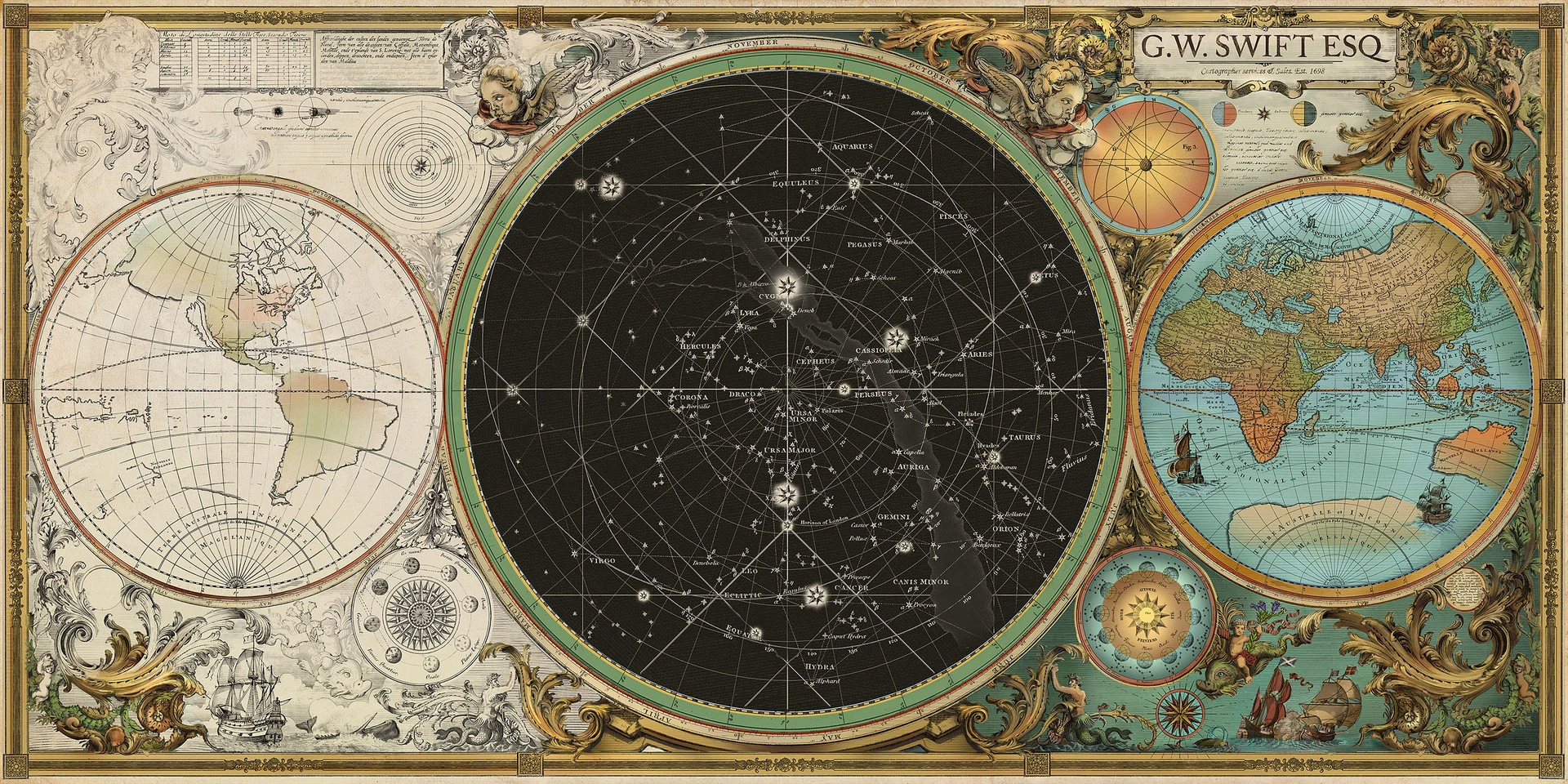

The maps of the world, the sea, the sky, and stars as seen in the Swift and Sons Chart House in Saint Martin.
- "Jack Sparrow is a dying breed. The world is shrinking, the blank edges of the map filled in. Jack must find his place in the New World or perish."
- ―Cutler Beckett
A map was a depiction of interrelationships, commonly spatial, between things within a space. Maps of geographic territory had a very long tradition and have existed from ancient times, annotated with various writings or text that may be displayed on paper or other durable medium. It was one of the most important and widespread inventions in human history, allowing humans to explain and navigate their way, having been found in several societies and cultures across the world even before the development of other written communication systems.
When and how the earliest maps were made is unclear, but maps of local terrain were believed to have been independently invented by many cultures. In their simplest forms, maps were two-dimensional constructs, and had been projected onto globes since the sphericity of the Earth was established by Greek astronomy in the 3rd century BC, and the earliest terrestrial globe appeared from that period. Although maps were commonly used to depict geographic territories and elements, they may be a visual representation of any space, real or fictional, notably used to search for various treasures as well as certain places.
History
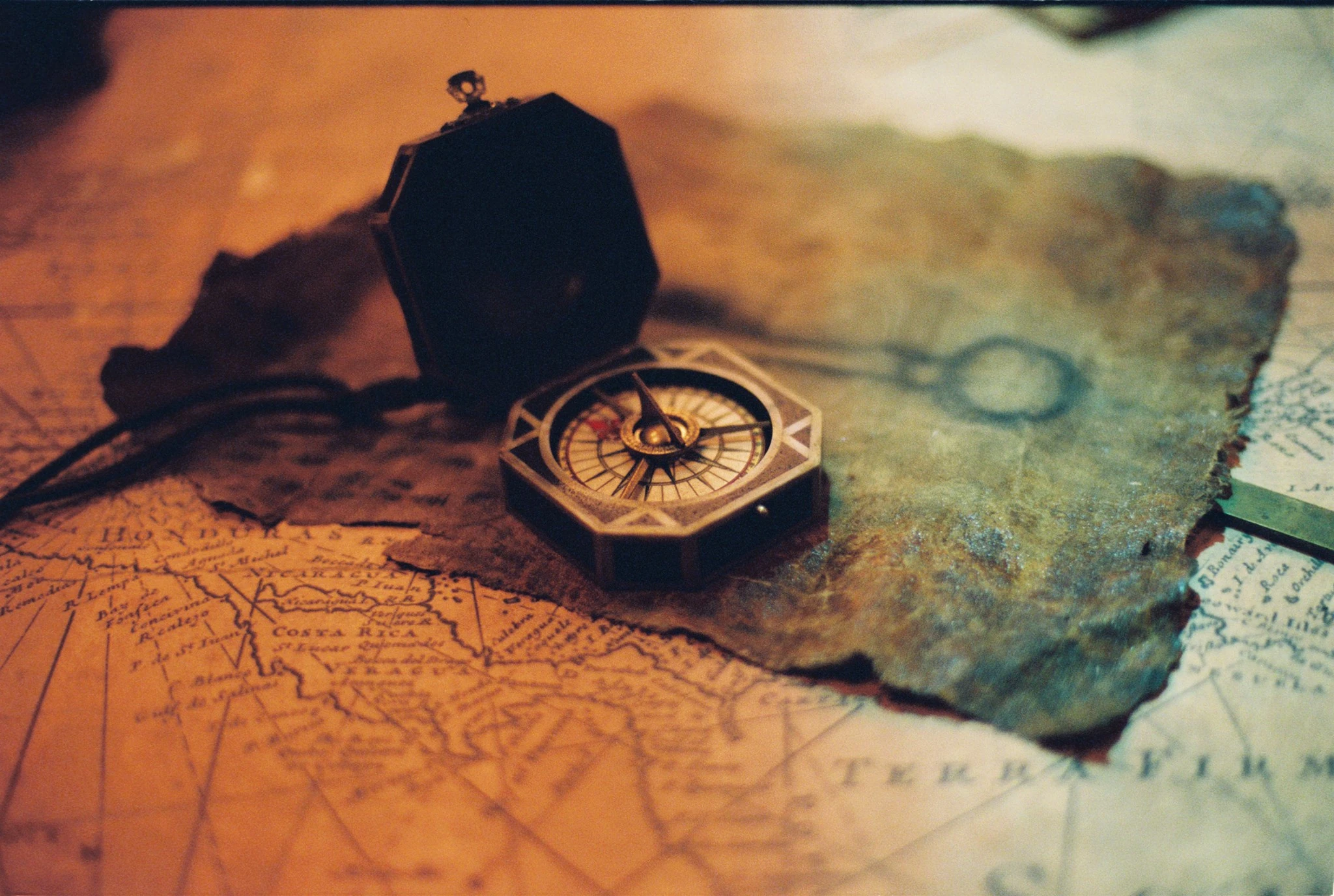

Captain Jack Sparrow's compass and a drawing of a key sitting on at least a map of South America aboard the Black Pearl.
- "Master Gibbs, short we are a map. Perhaps you'd be so kind as to provide us an heading."
- ―Hector Barbossa to Joshamee Gibbs
When and how the earliest maps were made is unclear, but maps of geographic territories had a very long tradition and have existed from ancient times and maps of local terrain were believed to have been independently invented by many cultures. It had been one of the most important and widespread inventions throughout human history, allowing humans to explain and navigate their way. In their simplest forms, maps are two-dimensional constructs, eventually being projected onto globes. By the Age of Piracy, a time in which the maps weren't yet filled in and Terra Incognita (lands that are unknown), there were many types of maps in both the Old and New World, including navigational charts, and treasure maps, used by Royal Navy officers and pirates, among other sailors and adventurers.[1][2][3]
The day after Elizabeth Swann was kidnapped from Port Royal by Captain Hector Barbossa and the crew of the Black Pearl, Commodore James Norrington of the British Royal Navy studied the map of the Lesser Antilles, trying to establish the most likely course the pirates took in the Caribbean. Not satisfied with Norrington's plan of action, young blacksmith Will Turner slammed his axe into the commodore's desk, through the map, cutting the island of Guadeloupe in half.[1] By the search for the Dead Man's Chest about one year later, Captain Bellamy of the Edinburgh Trader had a map of the Caribbean on the desk in his cabin, covered with port tariff papers issued by the East India Trading Company.[2]
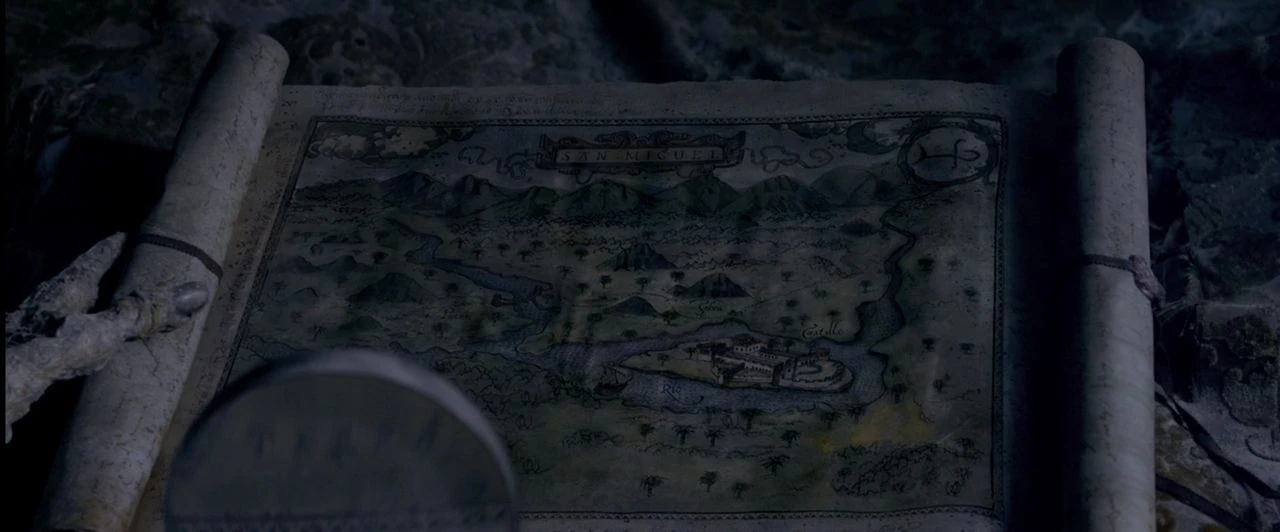

Ponce de León's map of San Miguel.
Some maps showed the entire world, like the map of the world in Lord Cutler Beckett's office.[2] Sao Feng's navigational charts, known as the Mao Kun Map, was a map with circular rings that represented metaphorical places to which its reader could locate some of the world's more obscure, mystical, and supernatural places;[3][4] the dates and distances could change and mislead the traveler who uses the map unwisely.[5] Sao Feng's map would be used by Hector Barbossa to find Davy Jones' Locker in the desperate quest to save Jack Sparrow, who later used a separate map within the charts at the beginning of the quest for the fabled Fountain of Youth.[3] Barbossa and Sparrow later found Ponce de León, now a skeletal figure lying in his bed aboard the stranded Santiago, peering at a map of San Miguel with a magnifying glass.[4]
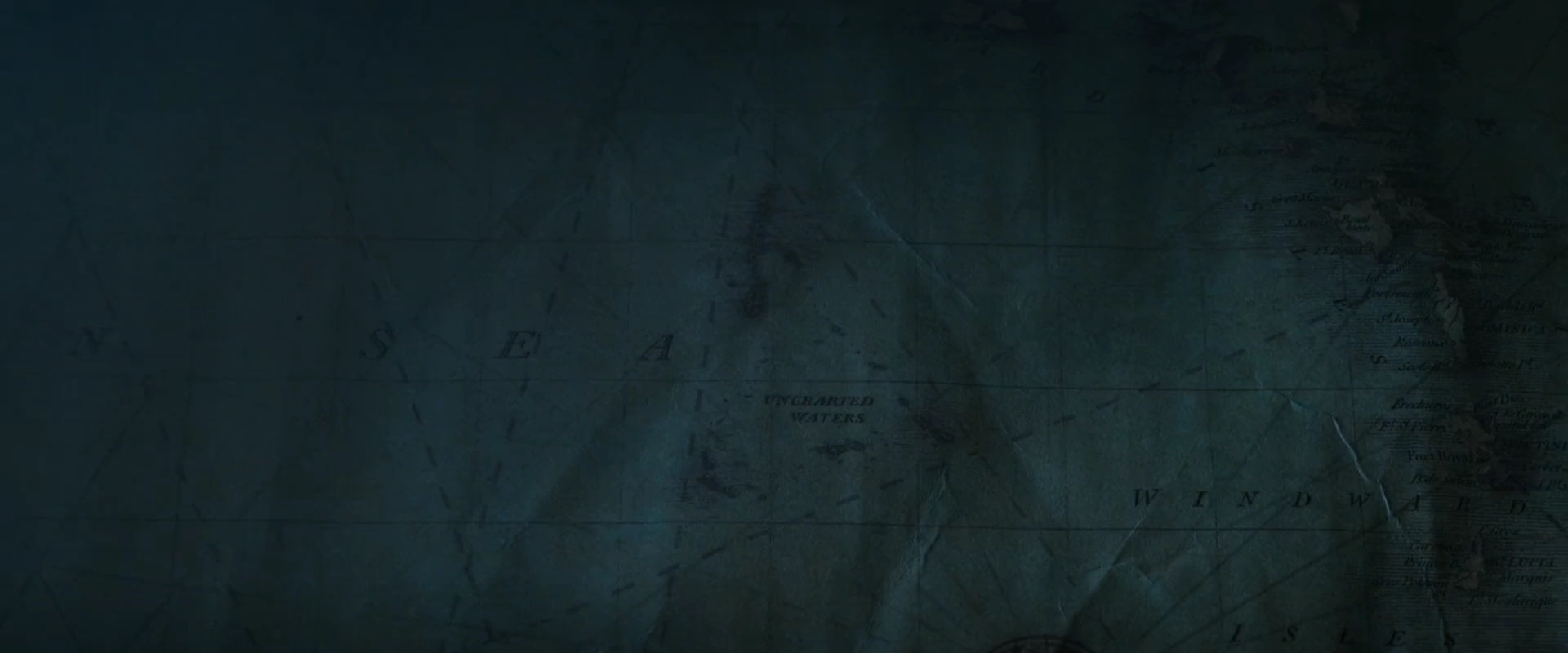

The British map of the area west of the Windward Isles in the Lesser Antilles.
When the British warship, the HMS Monarch, chased the pirate ship, the Ruddy Rose, into the waters west of the Windward Isles in the Lesser Antilles, which the young sailor Henry Turner identified as the Devil's Triangle, the Monarch's commanding officer Captain Toms checked his navigational charts, discovering that the area was named simply "Uncharted waters" prior to an attack by an army of the dead led by Armando Salazar. Later, during Hector Barbossa's search for the Trident of Poseidon, the young astronomer Carina Smyth warned the weathered sea captain of the Black Pearl that his map was incomplete. Eventually, realizing the map was indeed in the stars, Barbossa allowed Carina to steer the Pearl. Following Barbossa's second death, Jack Sparrow reclaimed his captaincy of the Black Pearl, where Joshamee Gibbs took some navigational charts, asking Sparrow what would be their next heading. When Sparrow simply replied that they would follow the stars, Gibbs enthusiastically threw the charts behind.[6]
Behind the scenes
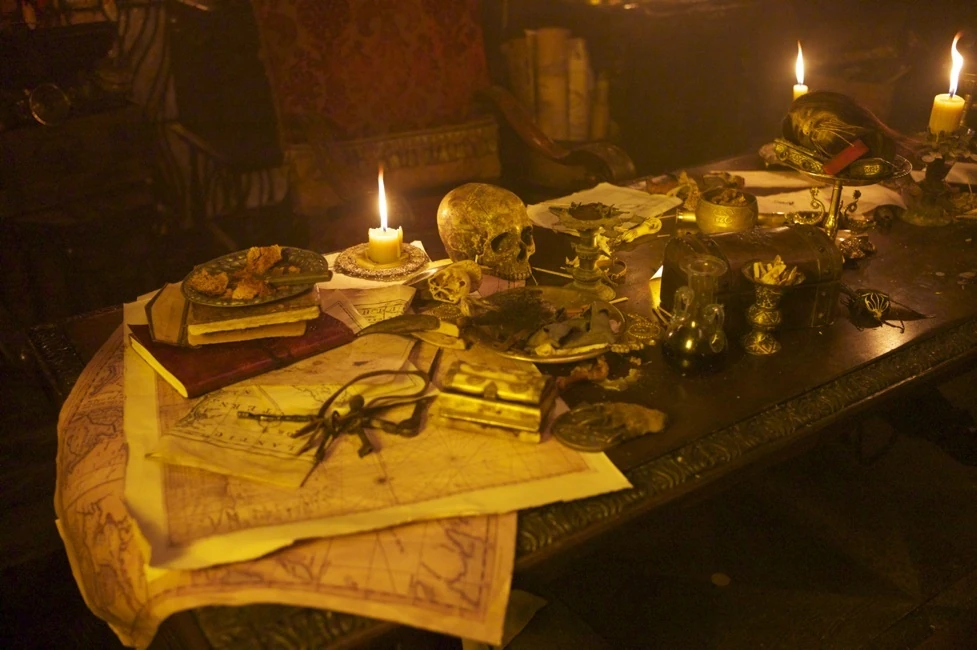

The seafaring charts in Blackbeard's cabin.
- "So I went back to an earlier idea that I had about a circular map with rings that represented metaphorical places to which you could travel, which I thought tied into the whole 'Pirates' theme. Gore and I had been talking about the notion that 'Pirates of the Caribbean' takes place during a time in history in which the maps weren't yet filled in, which means that anything is possible in the world. There are all these places in the world that are Terra Incognita-lands that are unknown-so they could have monsters, they could have magic, they could have new civilizations. I loved the idea that this map was very old, made before the Enlightenment, before people got so scientific about mapmaking, when they still blurred the geographical realities with metaphorical inner journeys which are as important as physical journeys."
- ―James Byrkit
Maps first appeared in Walt Disney's Pirates of the Caribbean, specifically in the "Captain's Quarters" tableaux where guests see a skeletal pirate in bed, peering at a map with a magnifying glass, surrounded by his treasure.[7] Sam McKim created a "fun map" of the attraction, which featured prominently in the original Pirates of the Caribbean souvenir book, where maps were first identified by name.[8] A map by Imagineer John Horny contained numerous winks and tributes, including the pirate beneath the name of the attraction as a caricature of Marc Davis, as well as small creeks bearing the names of John Horny's parents and Tietz Bay, a tribute to Chris Tietz.[9] In later years, the scene-setting tableau in the load area was enhanced with a parrot similar to Walt Disney World's Barker Bird, and a treasure map "marquee" upon which fiber-optics effects spell out the attraction's name. For the 2006 revamp of the ride, along with the addition of characters and elements from the films, the fiber-optic treasure map was replaced with a new interior marquee map designed by Jeremy Fulton, upon which the long-anonymous island port was officially named Isla Tesoro to better tie the location into an emerging, overarching Pirates mythology.[10]
In the 2003 film Pirates of the Caribbean: The Curse of the Black Pearl, during the battle of Isla de Muerta, Hector Barbossa tells Jack Sparrow "You're off the edge of the map, mate. Here there be monsters!"[1] It derives from the inscriptions on old maps of the mostly unexplored world, were on the edges, the mapmaker, having run out of information, would draw fanciful creatures (such as Sea Serpents) and write, Here There Be Monsters.[11][12] This is most likely a reference to the real-world phrase "Here be dragons" which medieval cartographers put on the maps along the illustrations of dragons, sea monsters and other mythological creatures to indicate potential dangers in uncharted areas.[13]
In Ted Elliott and Terry Rossio's first screenplay draft for The Curse of the Black Pearl, when Barbossa talked with Elizabeth Swann about the curse of the Aztec Gold, he opened his Captain's chest which contained a Mayan codex, gold, a sextant, and some charts.[14]
In Terry Rossio's 2012 screenplay draft for the 2017 film Pirates of the Caribbean: Dead Men Tell No Tales, Philip Swift lost contact with Syrena and became a cartographer so he could make a map that would lead to the treasure of all treasures, the legendary Mermaid Trove. The map eventually ended up in Jack Sparrow's possession who successfully found the Trove.[11][12]
In the non-canonical LEGO Pirates of the Caribbean: The Video Game, Ponce de León's logbook was stolen from the Spanish by Angelica, but not before King Ferdinand took from it the map with the route to the Fountain of Youth.
Appearances
- Walt Disney's Pirates of the Caribbean (First appearance)
- Climb Aboard If You Dare!: Stories From The Pirates of the Caribbean
- Jack Sparrow: The Coming Storm
- Jack Sparrow: Silver
- Jack Sparrow: The Timekeeper (Mentioned only)
- Pirates of the Caribbean: Six Sea Shanties
- The Price of Freedom
- Legends of the Brethren Court: The Caribbean
- Legends of the Brethren Court: Rising in the East
- Legends of the Brethren Court: The Turning Tide
- Legends of the Brethren Court: Wild Waters
- Legends of the Brethren Court: Day of the Shadow
- The Compass of Destiny!
- Pirates of the Caribbean: The Curse of the Black Pearl (video game)
- Pirates of the Caribbean: The Missing Pirate
- Pirates of the Caribbean: The Curse of the Black Pearl
- Pirates of the Caribbean: The Legend of Jack Sparrow
- Mother of Water
- The Capture of Jack Sparrow!
- The Compass of Destiny!
- The Eye of Despair!
- The Dark Skull
- The Lost Sea
- Pirates of the Caribbean Online
- Pirates of the Caribbean: Dead Man's Chest
- Pirates of the Caribbean: At World's End
- Pirates of the Caribbean: On Stranger Tides
- The Brightest Star in the North: The Adventures of Carina Smyth
- Pirates of the Caribbean: Dead Men Tell No Tales
- LEGO Pirates of the Caribbean: The Video Game (Non-canonical appearance)
- Sea of Thieves: A Pirate's Life (Non-canonical appearance)
Sources
- Walt Disney's Pirates of the Caribbean: The Story of the Robust Adventure in Disneyland and Walt Disney World
- Pirates of the Caribbean: From the Magic Kingdom to the Movies
- The Art of Pirates of the Caribbean: On Stranger Tides
- Disneyland Paris, From Sketch to Reality
- Maps of the Disney Parks: Charting 60 Years from California to Shanghai
External links
 Map on Wikipedia
- Nautical chart on Wikipedia
Notes and references
- ↑ 1.0 1.1 1.2 Pirates of the Caribbean: The Curse of the Black Pearl
- ↑ 2.0 2.1 2.2 Pirates of the Caribbean: Dead Man's Chest
- ↑ 3.0 3.1 3.2 Pirates of the Caribbean: At World's End
- ↑ 4.0 4.1 Pirates of the Caribbean: On Stranger Tides
- ↑ Pirates of the Caribbean: On Stranger Tides: The Visual Guide, pp. 26-27: "Mao Kun Map"
- ↑ Pirates of the Caribbean: Dead Men Tell No Tales
- ↑ The Art of Pirates of the Caribbean: On Stranger Tides
- ↑ Walt Disney's Pirates of the Caribbean: The Story of the Robust Adventure in Disneyland and Walt Disney World, p. 20
- ↑ Disneyland Paris, From Sketch to Reality
- ↑ Pirates of the Caribbean: From the Magic Kingdom to the Movies
- ↑ 11.0 11.1 Wordplayer.com: PIRATES OF THE CARIBBEAN: DEAD MEN TELL NO TALES by Terry Rossio
- ↑ 12.0 12.1 Pirates of the Caribbean - Dead Men Tell No Tales - Annotations - Terry Rossio - 8/14/12 - Page 24
- ↑ Here be dragons - Wikipedia
- ↑ Wordplayer.com: PIRATES OF THE CARIBBEAN: THE CURSE OF THE BLACK PEARL by Ted Elliott & Terry Rossio