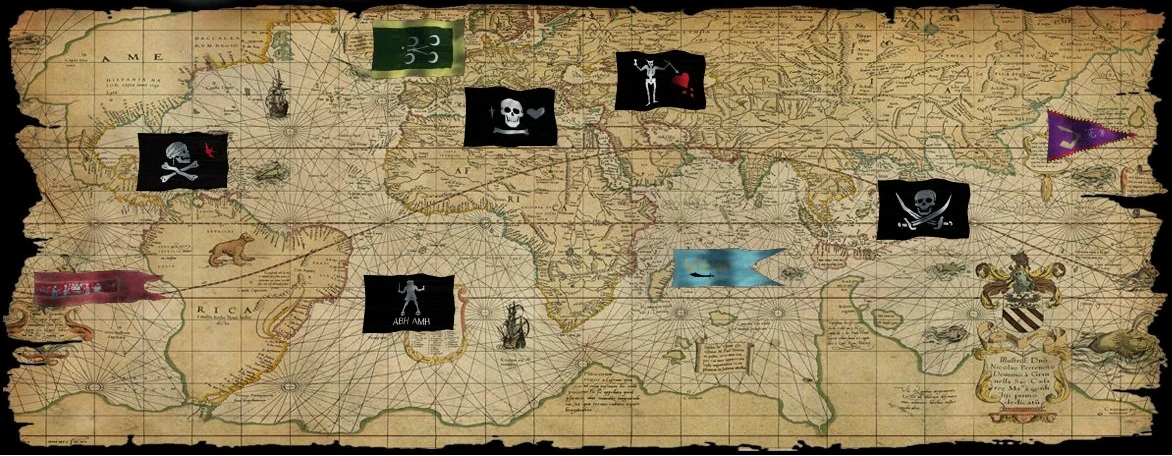
The four corners of the Earth has been depicted on various world maps.
- "The Pirate Lords from the four corners of the earth must stand together."
- ―Hector Barbossa
The four corners of the world, also referred to as four corners of the earth, referred to a portrayal of the four points of the compass in several astronomical and mythological systems, as well as a view of the globe by the 16th century. It divided the world into four continents: Africa, America, Asia, and Europe. Each of the four continents was seen to represent its quadrant of the world—Africa in the south, America in the west, Asia in the east, and Europe in the north. This division fit the sensibilities of the time, which also divided the world into four seasons, four classical elements, four cardinal directions, four classical virtues, etc. With the European discovery of the existence of Australia, the theme of the "Four Continents" lost much of its drive, though the iconography survived as the "Four Corners" of the world.
History
The term was coined at some point in time before the discovery of the New World. During the Age of Piracy, Captain Jack Sparrow wore a ragbag of garb from the four corners of the earth; whether it's a silk headscarf from Singapore or a pistol belt from Port Royal, he hadn't paid for any of it.[1] Around the time when the Fourth Brethren Court convened, Hector Barbossa believed that the Pirate Lords from the corners of the earth had to stand together.[2]
Behind the scenes
The term "four corners of the world" was first mentioned in the 2005 book Pirates of the Caribbean: From the Magic Kingdom to the Movies by Jason Surrell.[3] Although the similar term "four corners of the earth" was spoken for a line uttered by Hector Barbossa (Geoffrey Rush) heard in trailers for the 2007 film Pirates of the Caribbean: At World's End,[2] it was first used to detail Captain Jack Sparrow's garb, as published in Pirates of the Caribbean: On Stranger Tides: The Visual Guide.[1]
Appearances
- Pirates of the Caribbean: At World's End (First identified as four corners of the earth)
Sources
- Pirates of the Caribbean: From the Magic Kingdom to the Movies (First identified as four corners of the world)
- Pirates of the Caribbean: On Stranger Tides: The Visual Guide
External links


Notes and references
- ↑ 1.0 1.1 Pirates of the Caribbean: On Stranger Tides: The Visual Guide, pp. 8-9: "Captain Jack Sparrow"
- ↑ 2.0 2.1 Pirates of the Caribbean: At World's End (trailer)
- ↑ Pirates of the Caribbean: From the Magic Kingdom to the Movies