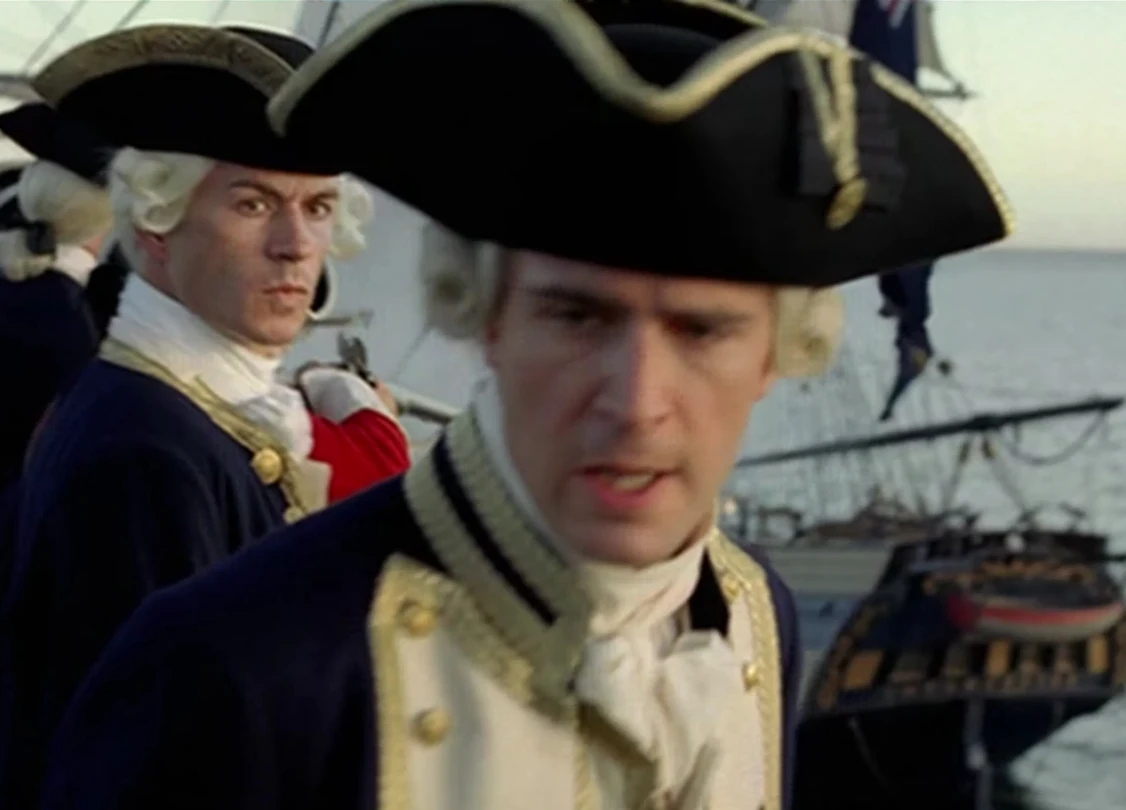
 |
| This article is about the book with the code's bylaws written in it. You may be looking for the rules and guidelines among pirates. |
- "That book is the Pirate's Code. Some of it goes way back."
- ―Jack Sparrow to Esmeralda
The Pirata Codex, also referred to as the Code of the Pirate Brethren book, Pirate's Code, Pirate Code or more commonly the Code, was a large book containing the entire Code of the Pirate Brethren set forth in the classic Age of Piracy by the Pirate Lords Morgan and Bartholomew. It was comprised of one thousand textured parchment pages.
History
Second Brethren Court
The Second Meeting of the Brethren Court produced a book containing the Pirates' Code, set down by the Captains and Pirate Lords[4][5] Morgan and Bartholomew,[3] and recorded in the Pirata Codex, so-named in haughty Latin,[9][10][11] and written in Arabic, Chinese, among other languages.[12] The Court held that the Code was law, but some would consider them more actual guidelines.[2]
Subsequent to the creation of the Code, new members of the Court were appointed, including the Keeper of the Code, who was its protector and herald. Upon request, the Keeper of the Code would interpret the Code as written, clarify points of contention, and announce his findings to the Pirate Lords. The Keeper designated his or her successor. The Keeper was assisted by the Carriers of the Code, two men assigned to deliver the Pirata Codex to the Pirate Lords when so ordered by the Keeper of the Code.[2]
At times when the very existence of pirates seemed imperiled, and the Brethren wish to declare an act of war against a common adversary, they could do so only upon the agreement and the election of a Pirate King. A Pirate King was selected by a popular vote of the nine Pirate Lords of the Court,[2] though each pirate only ever voted for themselves.[13][3] Prior to nomination, there were three qualities and requirements in order to become King: the applicant must be captain of a ship, swear by the Code, and have killed a man.[2][14] Once these prerequisites were proved, the elected King was sworn in by the Keeper of the Code. Duties of the Pirate King were detailed in the Pirata Codex and included declaring war, parlay with adversaries, assembling forces, and fashioning strategies. The method of summoning the Court was in the form of a song "Hoist the Colours"[2] used as a call.[3]
Age of Piracy
Throughout the Age of Piracy, the Pirata Codex book had embossed covers and weighed around eighty pounds.[9][10][11][12] It remained padlocked while not in use, with the key guarded by the Prison Dog. Captain Edward Teague served as the Keeper of the Code at Shipwreck Cove. The Code was commonly passed on by word of mouth, so the Codex itself was rarely consulted.[1]
The book was brought into the Great Chamber when Captain Teague organized the Court of Inquiry. The Pirate Lord of the Caspian Sea, Boris Palachnik, was accused of being one of the rogue pirates who deliberately broke the Code by slaughtering their prisoners and knowingly attacking other pirate ships. Despite several witnesses, Teague could not determine if Palachnik was guilty or not, so the assembled Pirate Lords decided to magically summon Davy Jones, the supernatural ruler of the sea, who could give them the definitive answer.[15]
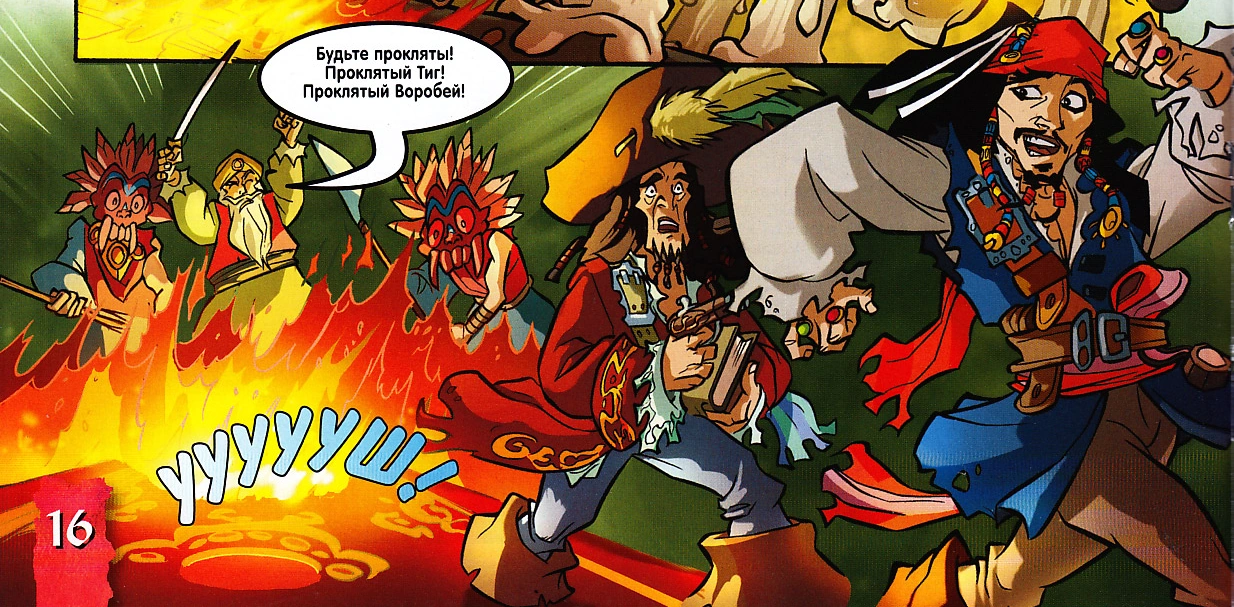
Teague and Jack escape with the book.
In unknown circumstances, the book was stolen by the Indian pirate Akshay, who took it to the island of Great Goa in the Indian Ocean. Since the book contained all the secrets of the Pirate Brotherhood, Akshay intended to give it to the East India Trading Company in exchange for the undisputed rule over the Indian Ocean. Teague followed Akshay but was captured and thrown into a pit at the bottom of Akshay's palace. Some time later Teague's son Jack Sparrow was also thrown into the pit and they managed to escape. Though Jack briefly abandoned Teague, leaving him to try to retreive the Codex on his own, he eventually came back, and the two of them escaped with the book.[16]
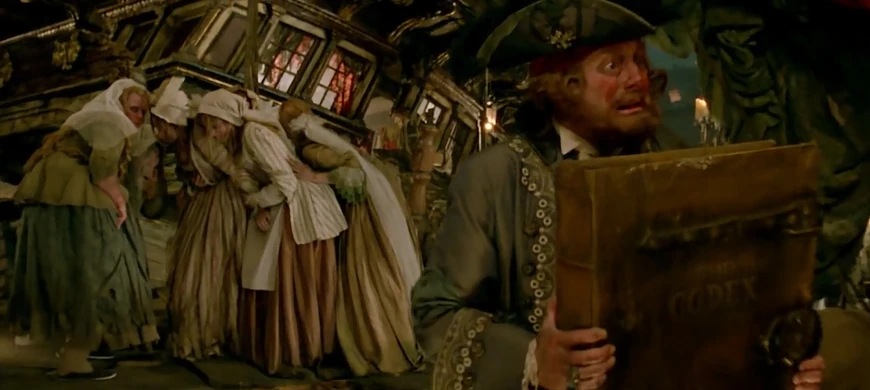
The Auctioneer holds the Code.
At some point after Jack Sparrow's departure from Shipwreck Island for Port Royal, the Auctioneer held an auction of numerous attractive wenches in Shipwreck City. The Pirata Codex book was lying on a table nearby. Scarlett and Giselle quickly rose to be the favorites of the lusty pirate crowd, eventually winning the price of seven hundred pieces of silver and two goats. However, the Auctioneer shackled the two women, stating that he owned them, as Jack had apparently sold both of them to him, and as per the Code he was free to resell them at profit. The self proclaimed guardian of the Code Mungard appeared and declared that the Code was the law as always, pushing the Auctioneer's hands from the book. Giselle then caused a great confusion which resulted in Mungard shooting at the Auctioneer. Fortunately for the Auctioneer, the bullet hit the Codex in his hands. At Mungard's orders, the book was quickly removed from the scene.[8]
Fourth Brethren Court
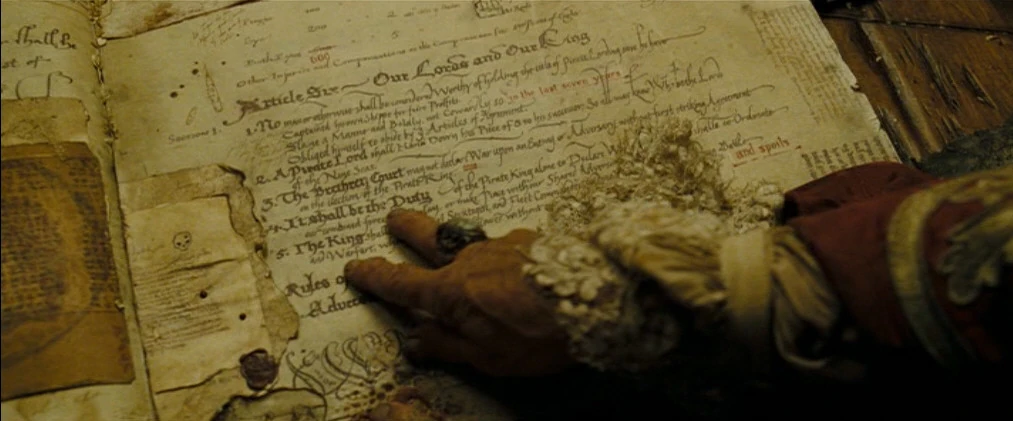
Captain Teague reads from the Code.
During the Fourth Brethren Court, Jack Sparrow disagreed with Captain Hector Barbossa's statemend that an act of war could be declared only by a Pirate King, Barbossa called on Teague. Sri Sumbhajee's aide Askay then declared that they should ignore the Code, but he was immediatelly shot dead by Captain Teague. The Codex was then brough into the Hall, the Prison Dog brought the keys, and Teague uncloked the book. After a short search through the book Teague confirmed that Barbossa was right.[3]
Notable articles
- "Code is the law."
- ―Edward Teague
Articles of the Pirata Codex included:
- The Right of Parley
- Artycle II, Section I, Paragraph VIII (sharing of the spoils)
- Artycle II, Section II, Paragraph I (whoever first spotted a treasure-laden ship could choose the best pistol for themselves)
The Codex also contained numerous rules and guidelines, including who the Pirate Lords were, what their Pieces of Eight were, what seas they were lord to, and how a Pirate Lord could become King.[12] There were also amendments for governing piracy in the South China Seas, on how marooning should be done,[1] and regulations about trading among pirates that anyone could buy something and resell it at profit.[8] There was also a passage mentioning mythic weapons, like the Trident of Poseidon, and strictly forbid pirates possessing such weapons, because they were too powerful and too dangerous.[17] The Codex was also filled with most unusual instructions, like a map to the rum locker which showed how to walk ten paces from the palm tree to the rum locker,[12] useful rum-based recipes,[1][10][11][12] recipes for beer, how to attack a ship, or where to find the best brothel in Singapore.[10][11][12]
Behind the scenes
Overview
The Pirata Codex, the book containing the Pirate's Code, first appeared in media relating to the 2007 film Pirates of the Caribbean: At World's End.[3] It was first detailed and identified as "Pirata Codex", "Pirate Code" or simply "the Code" in Pirates of the Caribbean: The Complete Visual Guide.[1] Along with the aforementioned names, "Pirate's Code" and the "Code of the Brethren book" was first used to describe the book in A. C. Crispin's 2011 novel The Price of Freedom.[7]
Creation and development
"Keep to the Code" was an oft-heard slogan regarding the Pirate's Code that first appeared in the 2003 film Pirates of the Caribbean: The Curse of the Black Pearl,[18] but At World's End featured the Pirata Codex, so named in haughty Latin, a mighty volume of overwhelming size which, in reality, was nothing less than an objet d'art of surpassing craftsmanship. The making of the book that Captain Teague (Keith Richards) consults for the Pirate Lords of the Brethren Court was covered in the film's production notes,[10] the book Bring Me That Horizon: The Making of Pirates of the Caribbean,[11] and the "Masters Of Design" bonus feature.[12] Regarding the opportunity with director Gore Verbinski, property master Kristopher E. Peck explained, "The Pirate Code book was something in the making for a very long time, and we had many people working on it. It had never been done before, and had to be grand and spectacular. I also wanted to put a lot of detail in it, even if it never ended up on film. But I knew that Gore is very detail-oriented, and I wanted to give him options to shoot. We had some trial and error with Gore, and I finally decided that he wouldn't see it again for approval until we got it right."[10]
Kris Peck had one meeting with Gore Verbinski, and another meeting with Verbinski and producer Jerry Bruckheimer, where Peck was trying to get information about "The Code" in the preliminary stages of the book. Among the ideas in the latter meeting were scribbles, stuck pages, recipes for rum and beer, the brothel in Singapore which Bruckheimer named "Rosie's Tavern", "Arabic, Chinese writing" and lipstick. Peck said he walked away from that meeting "a little beat up" and planned the Code book being done the next time,[12] and then contacted some craftspeople to come to Los Angeles, and after their meeting they worked until two o'clock in the morning in the production office writing the text and setting it down as quickly as they could.[9][10]
Tom Mallory, who was a writer for a San Diego newspaper, wrote the text based upon what they got from screenwriters Ted Elliott and Terry Rossio, things Peck discovered in his research, and storyline points that needed to be factored in.[9][10][11] According to Mallory, he wrote 22 pages of pirate rules for the Pirate Codex book,[19] which he also said was an amazing project and prop,[20] noting one text that he wrote: "... and musicians shall get the Sabbath off" that he wanted Richards' Teague to mutter that as he paged through the book.[21] Though it did not appear in the final version of the film,[3] the idea that "Musicians must play every day but Sunday" was mentioned by Peck in the "Masters of Design" feature.[12]
Peck and Mark Van Stone, who was an expert in ancient calligraphy and manuscripts, had previously combed through the manuscript archives of UCLA for inspiration. As recalled by Peck, "We walked into the basement, and there was this beautiful, big library room, low-key lighting as if you were going to see the Mona Lisa in the Louvre, and there was a 40-foot-long beautiful wooden table covered with manuscripts. They laid all of these old books out for us to look at, and we studied them microscopically. Mark pointed out little details that I would never have picked up on, like showing that certain parchment were embedded with the follicle hairs of a pig. We spent ten hours there, and walked away with this great archive of researching photos that we wanted to implement. Parchment was scarce back then, so you would see where they would scratch off the ink and write over it, or sew additions on top of the original paper. We tried to put ourselves in the pirate world, wondering what they would be doing, what they would be eating. Maybe there was a parrot on someone's shoulder, and the sunflower seeds that the bird was eating fell down into the middle of the book, or some ashes from a pipe they were smoking became ingrained into the paper."[9][10][11]
After Peck, Mallory and Van Stone completed their "first draft," conceptual consultant James Ward Byrkit became involved in the process, drawing illustrations, creating and adding other materials for the "super prop" that became the Pirata Codex.[10][11][12] Byrkit was a conceptual artist who usually worked right next to Verbinski and sketched a lot before Peck asked for his help. They came up with "some little stick figure, hobo type drawings" and do them in the corner, tearing the book, then sewed it back up, taking a torch and burned it.[12] Peck said, "Jim came up with some wonderful stuff, like how to attack a ship, or a castle. We have all kinds of things in the book, including recipes for beer, or where you can find the best brothel in Singapore. Jim helped us lay in the character and texture of the Pirate Code." They had rum and wine stains, fake blood stains, sunflower seeds, wax stamps and seals, and "addendums actually sewn onto the parchment pages."[9][10][11] In addition to the content relating to the Pirate Lords, Byrkit added a map to the rum locker that "some desperate pirate" put together, which was "probably the most valuable thing in the Code book."[12]
Kris Peck showed the Pirata Codex to Verbinski and Johnny Depp, and got "really good responses" from them before the next day they were going to shoot scenes in September 2006.[12] The final dimensions were 20" x 28", with the embossed covers an inch bigger, and the "hero" version of the book weighed about 80 pounds and contained a thousand pages of textured parchment.[9][10][11] Tony Leonardi, a standby painter, had been guestimating the weight by trying to lift it and remarked, "Too heavy for a prop."[12] On the first take Keith Richards' Teague opened up the Pirata Codex cover, he had to flip about three pages; he "nailed it great" on the first take, but by the second take, ten minutes in between, he couldn't get it open because the book was heavy. So Richards put it back down and said, "It's the movies, you know. The luggage never weighs as much."[12] Peck said, "So we had to make two books, because we had these two little old men in the film, sort of like a 90-year-old ZZ Top with beards down to here, playing the pirate librarians, who have to carry it. And since Captain Teague, played by Keith Richards, is the Keeper of the Code, we wanted to give him something easier to work with. So the second version only weighed about ten pounds."[9][10][11] They went back behind the set, took a saw, and cut half of it and "all the extra pages" out.[12]
Other media
Although Captain Teague and the Pirate Code book were absent in the first edition of the At World's End junior novelization, they did appear in the Special Edition version of the novelization. Also, the Code was mistakenly described as "set down by the First Court" during the Brethren Court scene from the Special Edition, rather than the Second Court, which was previously established by Hector Barbossa to Sao Feng in the Singapore scene from both editions.[6] The idea that the Code was set down during the Second Court would be mentioned in The Pirates' Guidelines,[2] as well as the Legends of the Brethren Court series.[4][5]
In the PlayStation 3 and Xbox 360 versions of the At World's End video game, the "Captain's log" which documents the player's progress through the game is a book modeled like the Pirata Codex.[13]
Both Captain Teague and the Pirata Codex appeared in the "Tears of the Goddess" comic, most notably published in the seventh issue of a Pirati dei Caraibi Magazine under the At World's End title in 2007.[16]
The Pirata Codex would be used as a basis of the "Rules of Pirate Conduct" pamphlet included in the Ultimate Trilogy Collection that released in 2011.[22]
Appearances


- Jack Sparrow: The Pirate Chase (Indirect mention only)
- The Price of Freedom (First identified as Code of the Brethren book)
- Legends of the Brethren Court: Rising in the East (Mentioned only)
- "Tears of the Goddess"
- Tales of the Code: Wedlocked
- Pirates of the Caribbean: At World's End (First appearance)
- Pirates of the Caribbean: At World's End (video game) (PlayStation 3 and Xbox 360 version)
- Pirates of the Caribbean: At World's End (junior novelization) (Special Edition)
- Pirates of the Caribbean: At World's End (Penguin Readers)
Sources
- Pirates of the Caribbean: The Complete Visual Guide (First identified as Pirata Codex or Pirate Code)
- The Pirates' Guidelines
- Bring Me That Horizon: The Making of Pirates of the Caribbean
- Pirates of the Caribbean: At World's End: "Inside the Brethren Court"
- Pirates of the Caribbean: At World's End: "Masters Of Design"
Notes and references
- ↑ 1.00 1.01 1.02 1.03 1.04 1.05 1.06 1.07 1.08 1.09 Pirates of the Caribbean: The Complete Visual Guide, pp. 10-11: "The Pirata Codex"
- ↑ 2.00 2.01 2.02 2.03 2.04 2.05 2.06 2.07 2.08 2.09 2.10 The Pirates'
CodeGuidelines, p. 5 - ↑ 3.00 3.01 3.02 3.03 3.04 3.05 3.06 3.07 3.08 3.09 Pirates of the Caribbean: At World's End
- ↑ 4.0 4.1 4.2 4.3 4.4 Legends of the Brethren Court: The Caribbean
- ↑ 5.0 5.1 5.2 5.3 5.4 Legends of the Brethren Court: Wild Waters
- ↑ 6.0 6.1 Pirates of the Caribbean: At World's End (junior novelization)
- ↑ 7.0 7.1 7.2 The Price of Freedom
- ↑ 8.0 8.1 8.2 Tales of the Code: Wedlocked
- ↑ 9.0 9.1 9.2 9.3 9.4 9.5 9.6 9.7 At World's End Production Notes: The Brethren Court (backup link archived on May 25, 2007)
- ↑ 10.00 10.01 10.02 10.03 10.04 10.05 10.06 10.07 10.08 10.09 10.10 10.11 10.12 POTC3 PressKit FINAL2/potc3 productionnotes.pdf (May 15, 2007) (backup link)
- ↑ 11.00 11.01 11.02 11.03 11.04 11.05 11.06 11.07 11.08 11.09 11.10 Bring Me That Horizon: The Making of Pirates of the Caribbean, p. 126
- ↑ 12.00 12.01 12.02 12.03 12.04 12.05 12.06 12.07 12.08 12.09 12.10 12.11 12.12 12.13 12.14 12.15 Pirates of the Caribbean: At World's End: "Masters of Design": Kris Peck: The Code Book
- ↑ 13.0 13.1 Pirates of the Caribbean: At World's End (video game)
- ↑ Pirates of the Caribbean: At World's End: "Inside the Brethren Court"
- ↑ The Price of Freedom, Chapter Eight, The Devil in the Deep Blue Sea
- ↑ 16.0 16.1 "Tears of the Goddess"
- ↑ Jack Sparrow: Bold New Horizons, p. 24
- ↑ Pirates of the Caribbean: The Curse of the Black Pearl
- ↑ Tom Mallory (@tom_mallory) on Twitter (post on November 9, 2021): "@RexChapman I wrote 22 pages of pirate rules for the Pirate Codex book that Keith Richard's Captain Teague consults in 'Pirates of the Caribbean: At World's End.'" (backup link)
- ↑ Tom Mallory (@tom_mallory) on Twitter (post on December 9, 2021): "Thank you! That was an amazing project, and an even more amazing prop they made out of it." (backup link)
- ↑ Tom Mallory (@tom_mallory) on Twitter (post on February 2, 2022): "In the text I wrote — and that, I must note, other craftspeople made come alive — is the rule, "... and musicians shall get the Sabbath off." I so wanted Keith to mutter that as he paged through the book, but I be but yer humble scribe and the fates be not that kind." (backup link)
- ↑ Pirates of the Caribbean: Ultimate Trilogy Collection: "Pirate Code of Conduct"