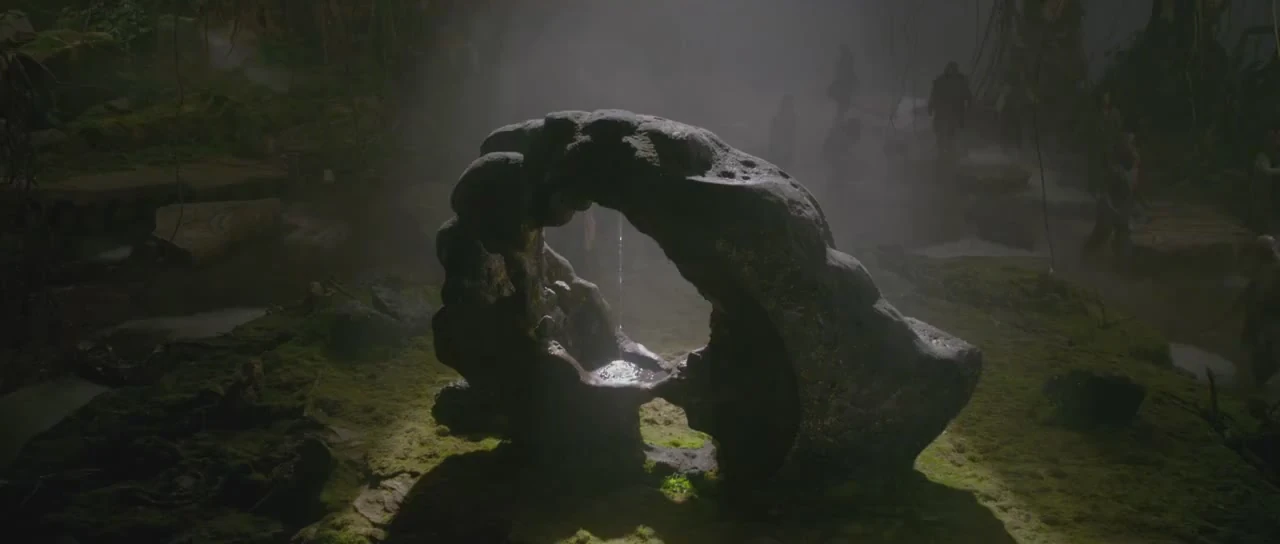
The Fountain of Youth was the prize sought by three different parties: the Spanish, the British, and Blackbeard's crew.
- "Will strikes a deal for this and uphold it on that, yet you were the one standing with the prize. Full pardon, commission as a privateer on behalf of England and the East India Trading Company. As if I could be bought for such a low price."
- ―Jack Sparrow
A prize is an award to be given to a person or a group of people to recognize and reward their actions and achievements. Some prizes were given to publicize noteworthy or exemplary behaviour, and to provide incentives for improved outcomes and competitive efforts. In general, prizes are regarded in a positive light, and their winners are admired.
The term is used in admiralty law to refer to equipment, vehicles, vessels, and cargo captured during armed conflict. The most common use of prize in this sense is the capture of an enemy ship and her cargo as a prize of war. The capturing force would commonly be allotted a share of the worth of the captured prize. Nations often granted letters of marque that would entitle private parties to capture enemy property, usually ships. Once the ship was secured on friendly territory, she would be made the subject of a prize case, an in rem proceeding in which the court determined the status of the condemned property and the manner in which the property was to be disposed of.
History
- "You heard the pirates in the mirror. They say the Black Pearl is the fastest ship in the entire ocean."
"Yes. What an excellent prize it will make. A reward for all the trouble I've gone to." - ―Barbara Huntington and Benedict Huntington
If there was some semblance of discipline and order within a pirate community it was usually due to the "articles", a contract stipulating the conditions and rules under which they sailed. Implicit in every set of articles was the axiom: no prey, no pay. Other conditions ranged from the sharing of the prize to a unique compensation plan for those who "should lose a leg or a hand in ye said service."[1] If a pirate was the first to locate the prize and found among the plunder a weapon that was better than his own, he was free to take it as his own. The rest of the items were chosen in turn with the Captain first, Master second, and so forth in seniority. Ship's musicians could lay claim to any instruments found among the spoils.[2]
After capturing the treasure ship Quedagh Merchant, William Kidd sailed for the Caribbean, his hold filled with booty from his prize—jewels, gold and silk.[3] When the legendary pirate Captain Edward Teague's ship, the Troubadour took a prize off the coast of Portugal, young crew member Jack Sparrow used his share to pay for fencing lessons.[4] Later, Sparrow didn't much care for fighting, because it was much safer and more chalenging to gain a prize by outwitting an opponent.[5]
One time the pirate ship the Venganza took a prize that was carrying Madeira, and for the next two weeks most of the crew were so drunk their Captain, Esmeralda, thought she would have to make sails herself. Following the capture of the East India Trading Company brig the Fair Wind, Esmeralda's crew enjoyed their prize belowdecks, swilling EITC rum with abandon.[6] Later, when Jack Sparrow and his first mate Robert Greene talked about their newest crewmember Chamba, Sparrow stated pirates would recognize a good man, and they would elect anyone captain that could bring them prizes, regardless of that man's skin color.[7]
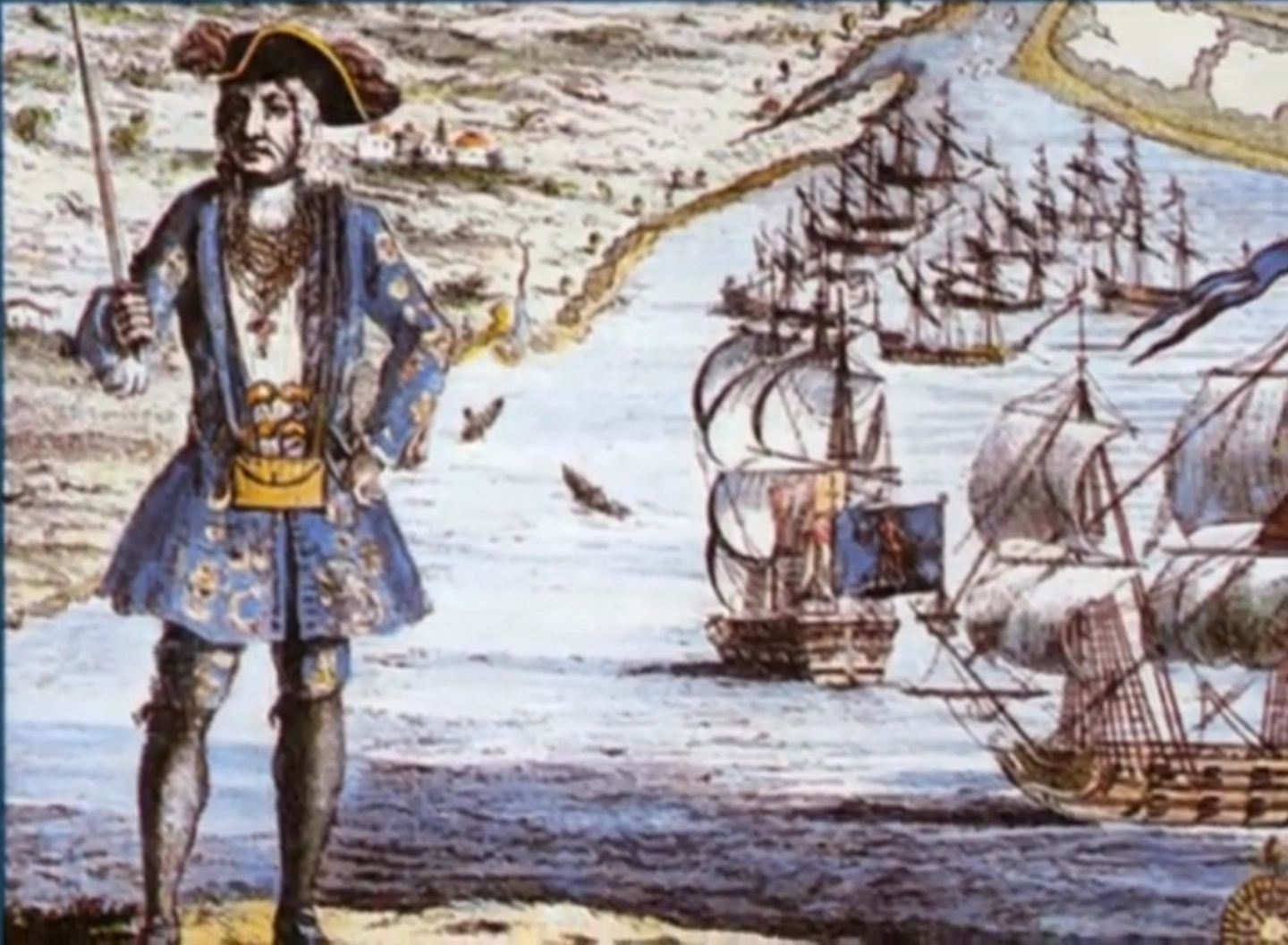
Bartholomew Roberts gave his crew over 400 prizes.
Edward Teach, better known as Blackbeard, was a grotesque spectacle in battle, with his chest was literally covered with pistols and knives. He braided his beard in pigtails, tying the ends with colorful ribbons. At the moment of boarding a prize, this lumbering arsenal would stick slow-burning matches in his beard and clamber over the side shouting curses and brandishing his cutlass. The sight of the ugly monster was enough to make the bravest man cower. Another pirate captain, Bartholomew Roberts, was unparalleled in the history of piracy. His crew respected his seamanship and obeyed his commands because their captain gave them over 400 prizes.[8]
The Black Pearl, originally an EITC merchant vessel turned legendary pirate ship by Captain Jack Sparrow's deal with the cursed Davy Jones, had a supernatural ability as the fastest ship in the entire ocean and was sought after as an excellent prize to many individuals, including Barbara Huntington and Benedict Huntington.[9] Following the capture of a Spanish galleon, the crew of the Pearl noticed the Centurion, the ship of the Spanish Pirate Lord Eduardo Villanueva, sailing toward them. The ship's first mate Hector Barbossa then declared that they should defend their prize like true pirates, brave and bold.[10] A few months later, at the beginning of the battle of Hong Kong, as the East India Trading Company forces ambused the Chinese pirates led by Sao Feng and Mistress Ching, the EITC official Benedict Huntington promised a prize to the agent who killed the most pirates.[11]
Following Jack Sparrow's escape from the Turkish Prison, his crewmen Joshamee Gibbs and Leech asked him if he had found what he was looking for, after which Sparrow showed the crew a rolled piece of cloth, but also revealed that he didn't have time to properly assess the prize.[12] On one occasion, Jack Sparrow and Joshamee Gibbs celebrated the taking of a prize in the infamous Tortugan tavern, the Faithful Bride. After the seventeenth toast, Gibbs fell asleep under the table, drunk, and Sparrow used that opportunity to borrow without permission some of Gibbs' share of the loot so he could use a room and a good wench.[13]
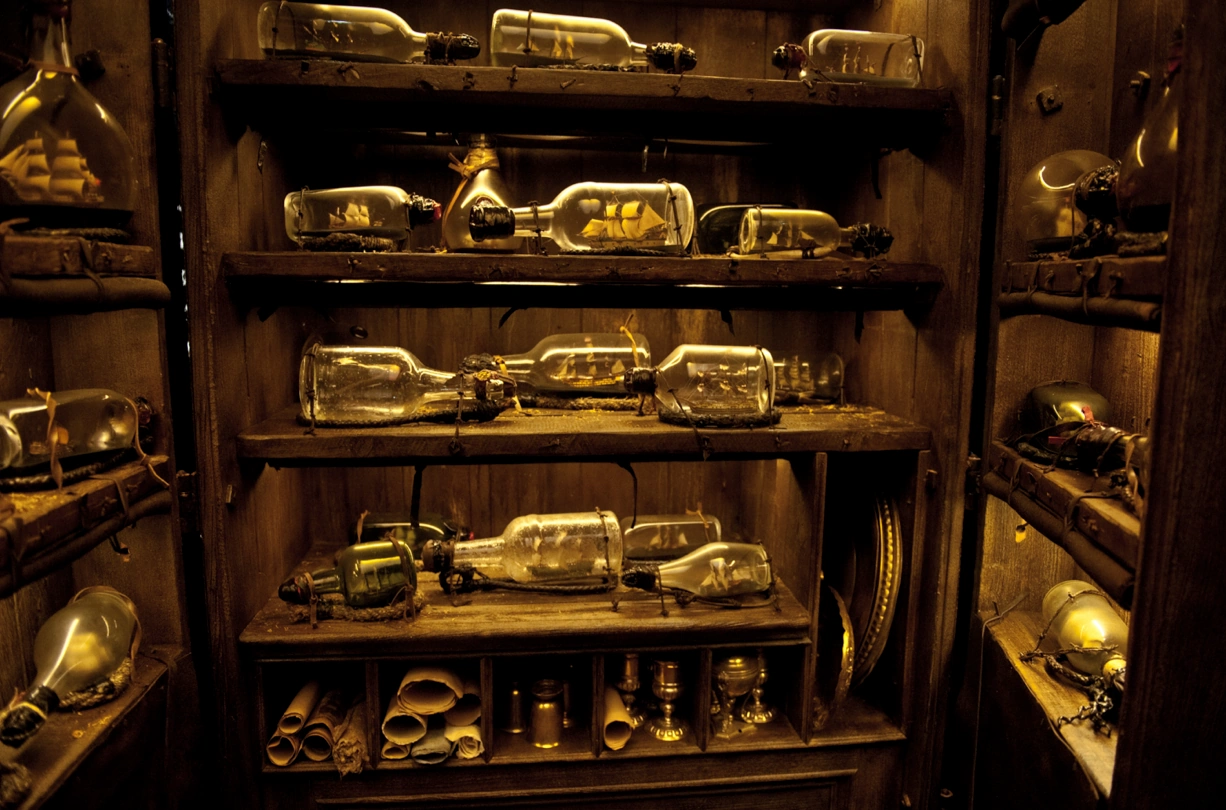
With every ship he captured over the years, turning them into shrunken ships in bottles, Blackbeard kept each ship as a prize.
Over the years, the notorious pirate Blackbeard attacked and captured many ships by bringing the ship's rigging to life against itself with the supernatural Sword of Triton, and then magicking the conquered vessels into shrunken ships enclosed in bottles for good measure, and kept each ship as a prize, trapped in their own kind of life inside the bottles. By the quest for the fabled Fountain of Youth, the Fountain was the prize sought by three different parties: The Spaniard's crew of the Spanish Armada, Privateer Hector Barbossa's crew of the British Navy, and Blackbeard's zombies and human crew.[14] The silver Chalices of Cartagena were the most valuable prize that could be found in the treasure chests of the wrecked Santiago.[15]
Behind the scenes
The term "prize" is first used in the souvenir book for Walt Disney's Pirates of the Caribbean.[1] Its first in-universe mention would be in Irene Trimble's junior novelization for the 2003 film Pirates of the Caribbean: The Curse of the Black Pearl, where after Jack the monkey brings the Aztec gold medallion to Captain Barbossa, he shouts "The prize is ours!"[16] rather than the line from the final cut of the film "Gents, our hope is restored!"[17]
In Ted Elliott and Terry Rossio's screenplay for Pirates of the Caribbean: At World's End, as seagulls were attracted to the dead bodies tied to barrels that served as Will Turner's breadcrumb trail left for Lord Cutler Beckett and the Endeavour to follow, a seagull pecks at the man's ear, flies away with the prize, pursued by others. Later, after Beckett tells Jack Sparrow to step forward and claim his reward during the parley on the sandbar. When Barbossa inquires about the supposed reward for Sparrow, Beckett pointed out that when the cannon smoke clears and the Brethren Court are slaughtered, Jack would sail on on the Black Pearl, Elizabeth Swann in his arms, and the blame dead square upon his rival, Will Turner.[18] Barbossa and Beckett's latter line did not make the final cut of the film, but was retained in the junior novelization.[19] In the 2009 novelization, Beckett instead tells Jack to claim his prize.[20]
Appearances
- Jack Sparrow: The Sword of Cortés
- The Price of Freedom
- Legends of the Brethren Court: The Caribbean
- Legends of the Brethren Court: Rising in the East
- Legends of the Brethren Court: Wild Waters
- Legends of the Brethren Court: Day of the Shadow
- Pirates of the Caribbean: The Curse of the Black Pearl (2003 junior novelization) (First appearance)
- Disney Adventures: "Revenge of the Pirates!"
- Disney Adventures: "Going Overboard!"
- Pirates of the Caribbean: Dead Man's Chest
- Pirates of the Caribbean: At World's End (junior novelization)
- Pirates of the Caribbean: At World's End (Penguin Readers)
- Pirates of the Caribbean: On Stranger Tides
Sources
- Walt Disney's Pirates of the Caribbean: The Story of the Robust Adventure in Disneyland and Walt Disney World (First identified as prize)
- The Pirates' Guidelines
External links


Notes and references
- ↑ 1.0 1.1 Walt Disney's Pirates of the Caribbean: The Story of the Robust Adventure in Disneyland and Walt Disney World, p. 5
- ↑ The Pirates'
CodeGuidelines, p. 24 - ↑ Walt Disney's Pirates of the Caribbean: The Story of the Robust Adventure in Disneyland and Walt Disney World, p. 15
- ↑ The Price of Freedom, Chapter Seventeen: A Matter of Honor
- ↑ The Price of Freedom, Chapter One: Fair Winds and Black Ships
- ↑ The Price of Freedom, Chapter Three: Doña Pirata
- ↑ The Price of Freedom, Chapter Six: The Wicked Wench
- ↑ Walt Disney's Pirates of the Caribbean: The Story of the Robust Adventure in Disneyland and Walt Disney World, p. 13
- ↑ Legends of the Brethren Court: Wild Waters, p. 5
- ↑ Legends of the Brethren Court: The Caribbean, p. 77
- ↑ Legends of the Brethren Court: Rising in the East, p. 181
- ↑ Dead Man's Chest (junior novelization), p. 4
- ↑ The Pirates'
CodeGuidelines, pp. 78-79 - ↑ Pirates of the Caribbean: On Stranger Tides
- ↑ Pirates of the Caribbean: On Stranger Tides: The Visual Guide, p. 13
- ↑ Pirates of the Caribbean: The Curse of the Black Pearl (2003 junior novelization), p. 84
- ↑ Pirates of the Caribbean: The Curse of the Black Pearl
- ↑ Wordplayer.com: PIRATES OF THE CARIBBEAN: AT WORLD'S END by Ted Elliott & Terry Rossio
- ↑ Pirates of the Caribbean: At World's End (junior novelization), pp. 162-163
- ↑ Pirates of the Caribbean: At World's End (Penguin Readers), p. 42