 |
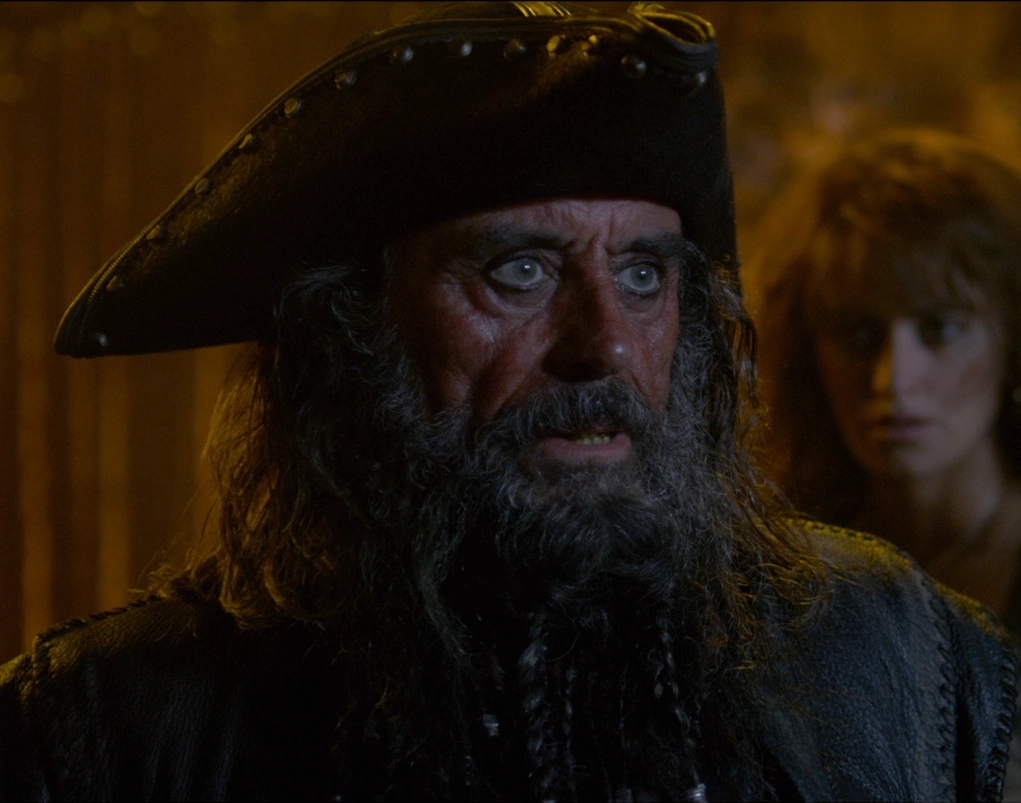
The infamous Blackbeard committed crimes on the high seas.
- "Jack Sparrow. Be it known that you have been charged, tried, and convicted for your willful commission of crimes against the Crown, said crimes being numerous in quantity and sinister in nature, the most egregious of these to be cited herewith."
- ―Town Clerk
A crime, is an act considered by a government or state harmful not only to some individual, but also to the community or the country. Such acts are forbidden and punishable by laws.
The government has the power to severely restrict one's liberty for committing a crime. Therefore, in some societies, a criminal procedure must be adhered to during the investigation and trial. Only if found guilty, the offender may be sentenced to punishment such as community sentence, imprisonment, life imprisonment or, in some jurisdictions, even death.
History
The age of piracy became a ruthless era in which no man was assured a safe and successful voyage, even if his ship were heavily armed and well escorted. From the Bahamas to Trinidad to the Florida Keys, pirates made the Caribbean a theater for atrocities and crimes. Every bay, island, and river outlet became a veritable fortress of piracy in its "golden age."[1]
Captain Edward Teague was a member for the Brethren Court, as Pirate Lord of Madagascar as well as the Keeper of the Code, and believed that the Code was the law.[2] Shipwreck Cove had its violent side, but actual murder was quite rare—especially the kind of clandestine crime Jack described.[3] Five years after Jack Sparrow broke the Code by facilitating the escape of rogue pirates, including his friend Christophe-Julien de Rapièr, Esmeralda said Sparrow could dispatch the rogues to expiate his crime, and with her to vouch for him, the Pirate Lords would cancel this death sentence.[4]
A notorious and infamous pirate, pillager, and highwayman, Captain Jack Sparrow was a man charged, tried, convicted and condemned to death for his willful commission of crimes against the British Crown and Empire.[5][6] One of Jack's earliest crimes as a teenage stowaway included tricking a six-year old boy into masquerading as an officer of the Crown.[7] His further crimes, as cited by the town clerk of Port Royal, included piracy, smuggling, falsification of Letters of Marque and Reprisal, impersonating an officer of the British Royal Navy, impersonating an officer of the Spanish Royal Navy, impersonating a cleric of the Church of England, sailing under false colors, arson, kidnapping, looting, poaching, brigandage, pilfering, depravity, depredation, and general lawlessness.[5] In addition to a detailed account of his criminal activities in Port Royal, Alberto Chaves of Fort Alvo Grande purportedly read more of the crimes of Captain Sparrow including drunkenness, treason, pillaging, chicanery, and disregard for public safety. According to Sparrow himself, the charge of depravity was a "terrible misunderstanding" as he "had no idea she was a woman" before trying to set the record straight about his "heroic inervention" at Port Royal.[8] For these crimes, Jack Sparrow was sentenced to be hung by the neck until dead,[5][8] decapitated at the guillotine,[9] and presided as a judge over his own murder trial, where the courtroom mistook Joshamee Gibbs for Sparrow himself.[10]
Near the end of the ten-year quest by Captain Hector Barbossa and the crew of the Black Pearl to lift their curse by the Treasure of Cortés, Barbossa told his crew that the punishment was disproportionate to their crime.[5] About one year after Jack Sparrow's escape from Fort Charles, Elizabeth Swann and Will Turner were charged of conspiring to set free a man lawfully convicted of crimes against the Crown, as written in arrest warrants presented by Lord Cutler Beckett of the East India Trading Company.[6] While aboard the Empress, the junk ship belonging to the Pirate Lord Sao Feng, Elizabeth said that some men offered desire as justification for their crimes.[2]
Edward "Blackbeard" Teach committed many crimes on the high seas, including, but not limited to, piracy, treason, murder, and torture. During the quest for the Fountain of Youth, Hector Barbossa, as a privateer with the authority granted by King George II, declared Blackbeard to be his prisoner for these crimes, including the brutal theft of Barbossa's right leg.[10]
Behind the scenes
The term "crime" first appeared in the souvenir book for Walt Disney's Pirates of the Caribbean.[1]
Appearances
- Pirates of the Caribbean: The Curse of the Black Pearl
- Pirates of the Caribbean: The Legend of Jack Sparrow
- Pirates of the Caribbean: Dead Man's Chest
- Pirates of the Caribbean: At World's End
- Pirates of the Caribbean: On Stranger Tides
- Pirates of the Caribbean: Dead Men Tell No Tales
Sources
- Walt Disney's Pirates of the Caribbean: The Story of the Robust Adventure in Disneyland and Walt Disney World (First identified as crime)
- The Secret Files of the East India Trading Company
External links


Notes and references
- ↑ 1.0 1.1 Walt Disney's Pirates of the Caribbean: The Story of the Robust Adventure in Disneyland and Walt Disney World, p. 4
- ↑ 2.0 2.1 Pirates of the Caribbean: At World's End
- ↑ The Price of Freedom, Chapter Eight: The Devil in the Deep Blue Sea
- ↑ The Price of Freedom, Chapter Fourteen: Hard Bargains
- ↑ 5.0 5.1 5.2 5.3 Pirates of the Caribbean: The Curse of the Black Pearl
- ↑ 6.0 6.1 Pirates of the Caribbean: Dead Man's Chest
- ↑ Jack Sparrow: The Tale of Billy Turner and Other Stories, p. 91
- ↑ 8.0 8.1 Pirates of the Caribbean: The Legend of Jack Sparrow
- ↑ Pirates of the Caribbean: Dead Men Tell No Tales
- ↑ 10.0 10.1 Pirates of the Caribbean: On Stranger Tides