|
"We are an unimaginative lot when it comes to naming things." The title of this article is conjectural. |
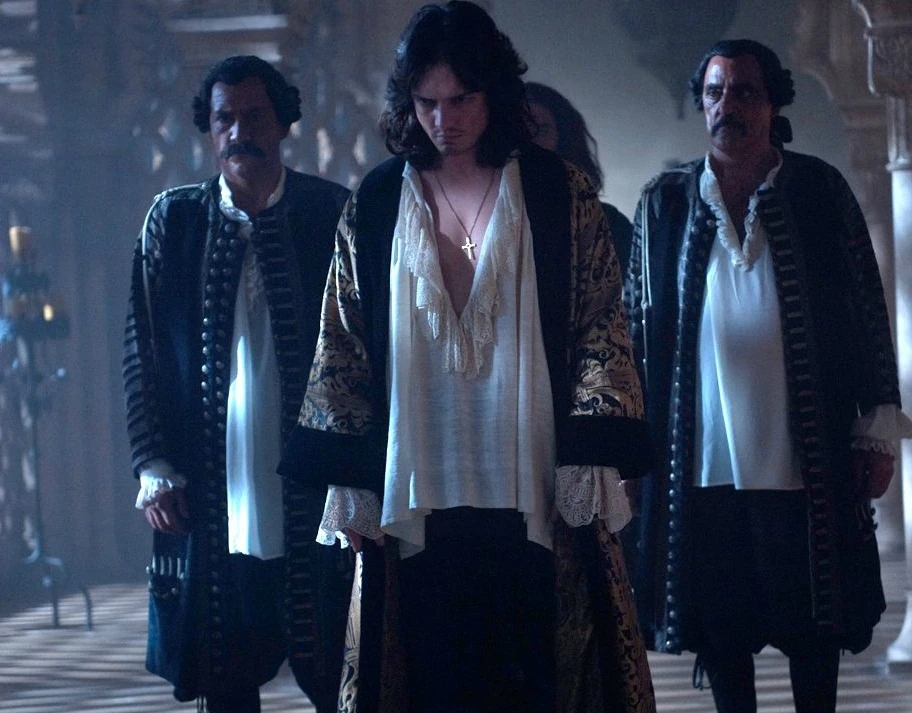

King Ferdinand was a Catholic monarch said to be divinely chosen by God to lead the Spanish people.
- "I have a report. The Spanish have located the Fountain of Youth. I will not have some melancholy Spanish Monarch—a Catholic—gain eternal life!"
- ―King George II
Catholicism, also known as the Catholic Church, was a branch of Christianity, the world's largest and most widespread religion. According to sacred traditions, beliefs, and faith, the church was founded by Jesus Christ and the authentic continuation of the Christianity, which generally hold in common the belief that Jesus was the son of God, whose coming as the messiah was prophesied in the Old Testament and chronicled in the New Testament of the Bible. By the Age of Piracy, both Christianity and Catholicism played a prominent role in the development of Western civilization.
History
The early history of Catholicism, otherwise known as the Catholic Church, is distinct yet inseparable from the origins of Christianity, the world's largest and most widespread religion which began with the life of Jesus Christ, whose followers proclaimed that he was the incarnation of God, born of a virgin named Mary, died by crucifixion, descended into hell, and had risen from the dead, whose arrival as the messiah was prophesied in the Old Testament and chronicled in the New Testament of the Bible. Through Jesus's crucifixion and resurrection, Catholics believed that God offered salvation and eternal life, with Jesus's death atoning for all sin. The use of depictions of Jesus was advocated by the leaders of denominations and the crucifix became the central ornament of the altar, a use that has been nearly universal in churches since then.[1][2]
By the Age of Piracy, the Spanish brought Catholicism over the course of several hundred years to various Caribbean islands.[3] Isla Cruces was an abandoned settlement, Spanish church,[4] and a water wheel would be set up on the island,[5][6] most likely by the Spanish bringing Catholicism to the Caribbean.[3] However, while it was said the Church brought salvation, it also brought disease and death to the island, resulting in a plague that wiped out the entire population. The priest buried the inhabitants, one by one, but he ultimately went insane for what happened and hanged himself at the church.[5][5][7]
By 1750, King Ferdinand, a Catholic,[8] was said to be divinely chosen by God to lead the Spanish people.[9] Upon gaining possession of the ship's log of Ponce de León, Ferdinand sent The Spaniard and his loyal crew of the Spanish Armada in a quest for the Fountain of Youth. Upon hearing this report, King George II of England did not want Ferdinand, a melancholy Spanish monarch as well as Catholic, to locate the Fountain so he sent the HMS Providence, captained by privateer Hector Barbossa, to claim the Fountain before the Spanish. Ultimately, the quest was successful for the Catholic soldiers, who managed to find the Fountain and destroy the profane temple. As a faithful Catholic, The Spaniard made the sign of the cross before leaving the ruins.[8]
Behind the scenes
The Catholic Church first appeared in the 2003 video game Pirates of the Caribbean.[citation needed]
In Ted Elliott and Terry Rossio's screenplay for Pirates of the Caribbean: Dead Man's Chest, Isla Cruces is described as "A tiny green island amidst a sapphire blue sea. Dominating the bluff an abandoned Spanish church." After spotting the abandoned church, Elizabeth Swann and James Norrington talk about the story of Isla Cruces with the Church bringing salvation and death to the island, with the priest burying every body before being driven mad and hung himself.[4] The scene with Elizabeth and Norrington as well as the hanged priest never made it to the final cut of the film, but they were retained in the film's junior novelization,[5] as well as the deleted/extended scenes "Salvation" and "For Whom the Bell Tolls" featured in Blu-ray releases beginning in 2011.[7] While unconfirmed in the film,[6] Rossio stated that Elizabeth was most likely referring to the Spanish who brought Catholicism over the course of several hundred years to various Caribbean islands.[3]
In Ted Elliott and Terry Rossio's screenplay for Pirates of the Caribbean: On Stranger Tides, The Spaniard's soldiers were described as "Catholic Soldiers" who all make the sign of the cross before the Spaniard throws the Chalices to the ground.[10] While King Ferdinand was described as a Catholic in the film,[8] neither he nor his soldiers were defined as Catholic in the junior novelization.[9]
Appearances
- Pirates of the Caribbean: Dead Man's Chest (Indirect mention only) (In deleted scene(s))
- Pirates of the Caribbean: On Stranger Tides
External links
Notes and references
- ↑
 Jesus on Wikipedia
- ↑ Catholic Church on Wikipedia
- ↑ 3.0 3.1 3.2 Wordplayer.com: SCRIPTS Message Board: Re: Religion subject in POTC, posted by Terry Rossio (June 18, 2025)
- ↑ 4.0 4.1 Wordplayer.com: PIRATES OF THE CARIBBEAN: DEAD MAN'S CHEST by Ted Elliott & Terry Rossio
- ↑ 5.0 5.1 5.2 5.3 Pirates of the Caribbean: Dead Man's Chest (junior novelization)
- ↑ 6.0 6.1 Pirates of the Caribbean: Dead Man's Chest
- ↑ 7.0 7.1 Pirates of the Caribbean: Dead Man's Chest (In deleted scene(s))
- ↑ 8.0 8.1 8.2 Pirates of the Caribbean: On Stranger Tides
- ↑ 9.0 9.1 Pirates of the Caribbean: On Stranger Tides (junior novelization)
- ↑ Wordplayer.com: WORDPLAY/Archives/Screenplay - PIRATES OF THE CARIBBEAN: ON STRANGER TIDES by Ted Elliott & Terry Rossio